Best Merchant of Record for Indie Hackers (2026)
Table of Contents
- TL;DR: Best merchant of record for indie hackers
- Merchant of record providers versus payment processors
- Paddle vs Lemon Squeezy vs Dodo Payments: fees compared
- Illustrative effective-cost calculations
- Example 1: 100 domestic sales at $29
- Example 2: 500 domestic $20 monthly renewals
- Merchant of record providers by product type
- Eligibility, country access and prohibited products
- Reserves, refunds, chargebacks and payouts
- How to choose a merchant of record for SaaS
- Mobile-app warning
- Bottom line
- TL;DR: Best merchant of record for indie hackers
- Merchant of record providers versus payment processors
- Paddle vs Lemon Squeezy vs Dodo Payments: fees compared
- Illustrative effective-cost calculations
- Example 1: 100 domestic sales at $29
- Example 2: 500 domestic $20 monthly renewals
- Merchant of record providers by product type
- Eligibility, country access and prohibited products
- Reserves, refunds, chargebacks and payouts
- How to choose a merchant of record for SaaS
- Mobile-app warning
- Bottom line
TL;DR: Best merchant of record for indie hackers
For conventional SaaS, start with Paddle if it supports your location and product. Compare Dodo Payments when founder-country coverage or price matters. Add Stripe Managed Payments if keeping an existing Stripe workflow justifies its layered fees.
Choose Lemon Squeezy for simple digital products, Freemius for plugins and downloadable software, and Gumroad for creator products. Treat FastSpring as a quote-based option.
All facts and calculations were checked against official sources on July 24, 2026. Pricing and eligibility can change.
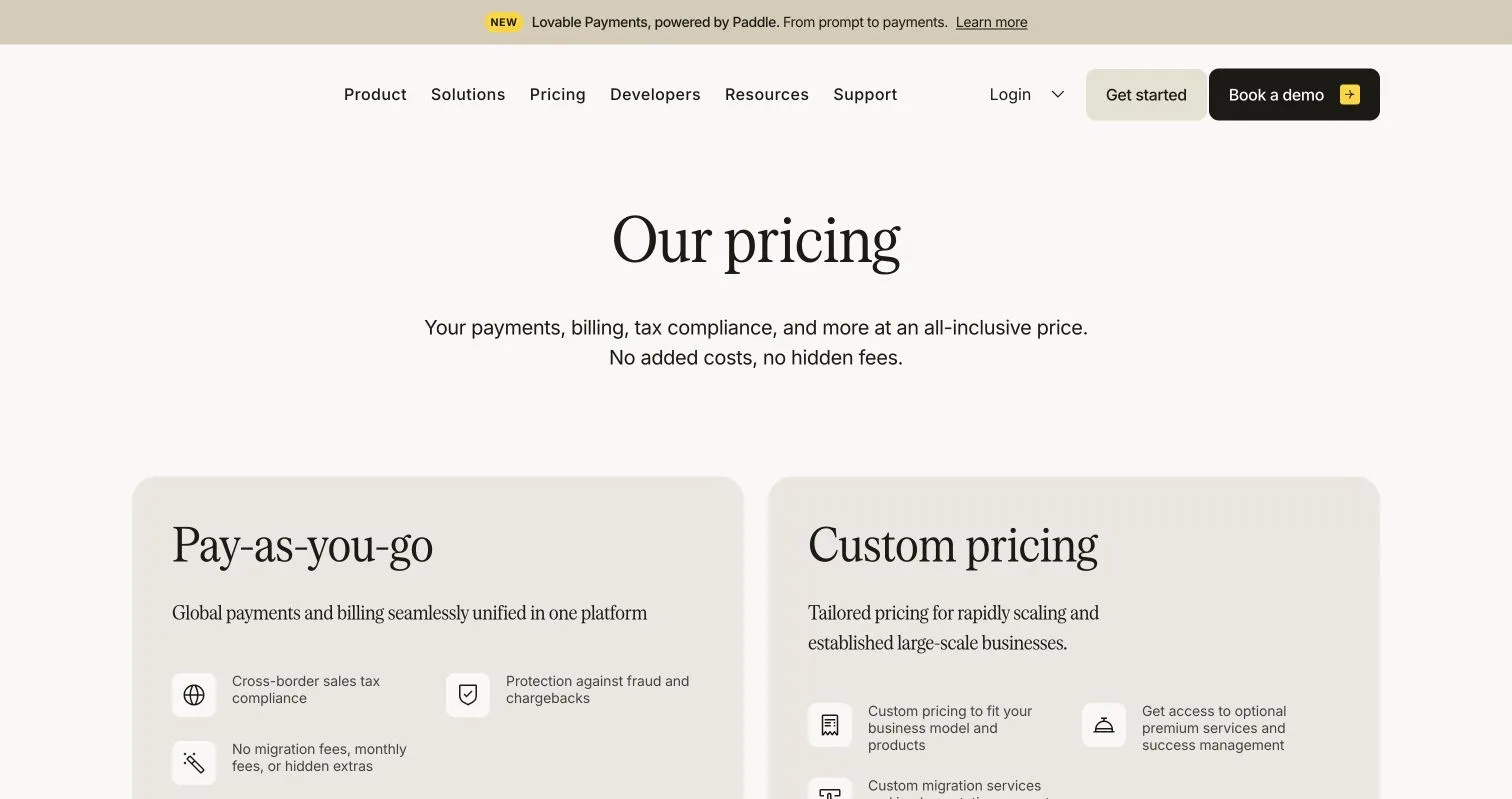
Official source captured in Chrome on July 25, 2026. Open the image link for the current page.
Merchant of record providers versus payment processors
A payment processor handles checkout and payments, but your company normally remains the legal seller and must manage applicable sales tax, VAT or GST.
A merchant of record (MoR) resells your product, appears as the seller and assumes covered transaction obligations. Paddle, for example, calculates, collects and remits applicable indirect tax and issues compliant invoices (Paddle tax documentation).
| Responsibility | Payment processor | Merchant of record |
|---|---|---|
| Legal seller | Your business | MoR entity |
| Sales tax, VAT and GST | Usually your business | MoR for covered transactions |
| Invoices and receipts | Configured by you | Issued by or for the MoR |
| Refunds and disputes | Managed by you | Administered under MoR rules |
| Chargeback losses | Your balance | Usually deducted from your proceeds |
| Subscription state | Your billing system | MoR platform, API and webhooks |
| Settlement | Processor settles funds | MoR pays net supplier proceeds |
An MoR does not handle product delivery, customer success, privacy compliance or corporate income tax. Dodo explicitly limits its tax role to indirect transaction taxes (Dodo MoR documentation).
Paddle vs Lemon Squeezy vs Dodo Payments: fees compared
These are published standard rates, not negotiated offers. Percentages may apply to tax-inclusive amounts.
| Provider | Published standard fee | Material extras |
|---|---|---|
| Paddle | 5% + $0.50 | Card disputes: $15, £15 or €15; PayPal disputes: $20, £20 or €20. Custom pricing is available for products under $10 (pricing; chargebacks). |
| Lemon Squeezy | 5% + $0.50 | +1.5% international, +1.5% PayPal and +0.5% subscriptions. Non-US bank payouts cost 1%; non-US PayPal payouts cost 3%, capped at $30 (fees). |
| Dodo Payments | 4% + $0.40 | +1.5% for payment methods outside the US, +0.5% subscriptions, +3% PayPal or BNPL, $1 refunds and $30 disputes. Payouts below $1,000 cost $5; USD SWIFT costs $25 (pricing). |
| Freemius | 4.7% plus gateway fees | Reported average gateway rate: 3.5%, not guaranteed. Lost disputes cost $15–$20. WordPress and template features add 2.3% (pricing documentation). |
| Gumroad | 10% + $0.50 direct | Discover sales cost 30%. Creators cover chargeback amounts and processing fees; Gumroad returns its platform fee (pricing; chargebacks). |
| Stripe Managed Payments | 3.5% plus Stripe processing | US cards: 2.9% + $0.30. Stripe Billing adds 0.7% to pay-as-you-go subscription volume. Disputes cost $15 (Managed Payments pricing; Stripe pricing). |
| FastSpring | Quote required | Public pages confirm tax, invoicing and dispute support but publish no standard self-serve rate (MoR page). |
Dodo has the lowest base rate listed, but international, subscription and payout charges can narrow the difference. Lemon Squeezy’s surcharges make international subscriptions materially more expensive than its headline rate.
Illustrative effective-cost calculations
These examples use public US rates as of July 24, 2026. They exclude tax, refunds, disputes, FX, PayPal, payout fees, negotiated rates and revenue-recovery products. They are illustrations, not quotes.
Example 1: 100 domestic sales at $29
| Provider | Fees | Effective rate |
|---|---|---|
| Dodo Payments | $156 | 5.38% |
| Paddle | $195 | 6.72% |
| Lemon Squeezy | $195 | 6.72% |
| Stripe Managed Payments | $215.60 | 7.43% |
| Gumroad | $340 | 11.72% |
Example 2: 500 domestic $20 monthly renewals
| Provider | Illustrative monthly fees | Effective rate |
|---|---|---|
| Dodo Payments | $650 | 6.50% |
| Paddle | $750 | 7.50% |
| Lemon Squeezy | $800 | 8.00% |
| Freemius | About $820 | about 8.20% |
| Stripe Managed Payments | $860 | 8.60% |
Freemius uses its reported average gateway rate, not a guaranteed quote. Fixed fees dominate low-priced products: a $0.50 charge is already 10% of a $5 sale. Ask about low-price or volume pricing.
Merchant of record providers by product type
These are editorial recommendations based on documented support, fees, billing models and country coverage.
| Product | Evaluate first | Decision rule |
|---|---|---|
| B2C or B2B SaaS | Paddle, Dodo, Stripe Managed Payments | Start with Paddle; price Dodo for geography or cost; consider Stripe when preserving your existing workflow matters. |
| AI SaaS with usage billing | Dodo, Paddle, Stripe Managed Payments | Test metering, credits, proration and webhook ordering. Stripe requires Billing. |
| E-books, templates and downloads | Lemon Squeezy, Dodo, Gumroad | Use Lemon Squeezy or Dodo for your storefront; choose Gumroad when creator tools or marketplace exposure justify its fee. |
| WordPress plugins and themes | Freemius | Model its additional WordPress solution fee. |
| Desktop software | Freemius, Paddle, FastSpring | Compare licensing, offline activation, refund revocation and update delivery. |
| Mobile apps | Store billing first | Store rules can override your preferred web checkout. |
| Emerging-market founders | Dodo, Freemius, Lemon Squeezy | Verify the exact KYC country and payout rail before integrating. |
| Third-party marketplace | None by default | You may need platform payments rather than a retail MoR. |
For architecture references, see the AnyPoss AI app builder directory, ShipFast-style SaaS stack and modern AI chat app stack.
Eligibility, country access and prohibited products
Confirm both where customers can pay and where your legal entity can pass KYC and receive payouts.
| Provider | Eligibility and restrictions |
|---|---|
| Paddle | Account and domain verification required. Monthly payouts have a $100 minimum (payout documentation). Built for software; physical goods, unrelated human services, payment services and marketplaces are prohibited (acceptable-use guidance). |
| Lemon Squeezy | Publishes supported bank and PayPal payout countries (countries). Designed for digital products; unlawful, adult, regulated, infringing and various high-risk products are prohibited (terms). |
| Dodo Payments | Its acceptance policy lists 185 countries and territories. Manual services, adult content and deceptive or high-risk businesses are prohibited (acceptance policy). |
| Freemius | Documents payouts in 190+ countries (countries). Supports software, not physical goods, human services, hosting or third-party marketplaces (product policy). |
| Stripe Managed Payments | Available to businesses in its published list. Supports direct sales of eligible digital products, not services, physical goods, marketplaces or job boards (eligibility). |
| Gumroad | Payout method varies by country. Services, PLR products, adult material and infringement can lead to suspension (suspension policy). |
For AI products, disclose the actual output category. Medical advice, impersonation, explicit content or infringement may be restricted even when the underlying product is software. Retain written approval.
Reserves, refunds, chargebacks and payouts
MoR status does not transfer every loss. Paddle deducts disputed amounts and fees from seller balances. Lemon Squeezy generally deducts the refunded amount and a $15 dispute fee and may refund within 60 days to prevent a chargeback (refund policy). Stripe may also issue certain refunds within 60 days.
Public documentation establishes no universal reserve percentage. Holds can be account-specific. Gumroad may delay payouts for security, compliance or unusual activity (payout delays); Freemius may modify payout terms or hold pre-order funds.
Before signing, get these terms in writing:
| Item | Confirm |
|---|---|
| Reserve | Percentage, duration, release rule and application to renewals |
| Negative balance | Whether future sales, bank debits or guarantees cover losses |
| Refund authority | When the provider may refund without your approval |
| Payout | Schedule, threshold, currencies, FX spread and wire fees |
| Exit | Subscription export, payment-method portability and webhook history |
How to choose a merchant of record for SaaS
-
Eliminate ineligible providers. Check your entity, country, product, customer locations and payout method.
-
Model your real transaction mix. Include order value, renewals, international cards, PayPal, refunds, disputes, FX and payout fees.
-
Prototype the full lifecycle. Test purchases, duplicate webhooks, upgrades, failed renewals, cancellations, refunds, disputes and entitlement revocation.
-
Confirm control boundaries. Identify who owns invoices, transaction emails, billing support and the customer portal. Stripe Managed Payments uses Link as the MoR (workflow documentation).
-
Get risk terms in writing. Confirm reserves, payout holds and product eligibility before sending production traffic.
Prioritize eligibility, product fit and lifecycle reliability before fees. A one-point saving is irrelevant if you cannot receive payouts or reliably revoke access after refunds.
Mobile-app warning
Apple generally requires In-App Purchase for digital features consumed in an app, subject to storefront-specific exceptions (App Review Guidelines). Google Play similarly requires Play Billing unless an applicable alternative-billing or external-offer program applies (Google Play payments policy).
Before using a web MoR with a mobile app:
- Check every target storefront and app category.
- Keep web and store entitlements in one server-side ledger.
- Verify purchases before granting access.
- Recheck policies before release.
Bottom line
For bootstrapped SaaS, shortlist Paddle and Dodo Payments. Add Stripe Managed Payments if you already depend heavily on Stripe. Choose Lemon Squeezy for simple digital products, Freemius for software licensing and plugins, and Gumroad for creator commerce. Evaluate FastSpring by written quote.
Do not commit until you have tested the subscription lifecycle and confirmed eligibility, reserves and payouts in writing.
Frequently asked questions
Which merchant of record is best for a bootstrapped SaaS?
Paddle is a strong default when it supports your location and product. Compare Dodo Payments for price or founder-country coverage, and Stripe Managed Payments when preserving an existing Stripe workflow matters.
Does a merchant of record handle all of my tax and compliance obligations?
No. It generally handles applicable sales tax, VAT or GST for covered transactions. You remain responsible for income tax, privacy, product delivery and customer support.
How should I compare merchant of record fees accurately?
Model order values, renewals, international payments, PayPal, refunds, disputes, foreign exchange and payouts. Fixed charges and surcharges can materially change the effective rate.
What should founders verify before integrating a provider?
Confirm acceptance of your legal entity, country, product, customer locations and payout method. Obtain written approval for unusual or potentially restricted products.
Will a merchant of record absorb refunds and chargeback losses?
Usually not. Transaction amounts, dispute fees and negative balances may still be deducted from your proceeds. Confirm reserves, refund authority and negative-balance rules.
What technical flows should I test before going live?
Test purchases, duplicate and delayed webhooks, upgrades, failed renewals, cancellations, refunds, disputes and entitlement revocation. Grant access only through verified server-side events.
Can I use a web merchant of record for purchases in a mobile app?
Not automatically. Apple and Google may require their billing systems for in-app digital features. Review each storefront and maintain one server-side entitlement ledger across web and store purchases.